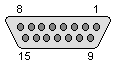
The DB15 connector brings out 12 additional digital I/O. It has the potential to be used as an expansion bus, where the 8 EIO are data lines and the 4 CIO are control lines.
In the Windows driver, the EIO are addressed as digital I/O bits 8 through 15, and the CIO are addressed as bits 16-19.
These 12 channels include an internal series resistor that provides overvoltage/short-circuit protection. These series resistors also limit the ability of these lines to sink or source current. Refer to the specifications in Appendix A.
All digital I/O on the UE9 have 3 possible states: input, output-high, or output-low. Each bit of I/O can be configured individually. When configured as an input, a bit has a ~100 kΩ pull-up resistor to 3.3 volts. When configured as output-high, a bit is connected to the internal 3.3 volt supply (through a series resistor). When configured as output-low, a bit is connected to GND (through a series resistor).
Table 2.13-1. DB15 Connector Pinouts
|
DB15 Pinouts |
|
|
|
|
1 |
Vs |
9 |
CIO0 |
|
2 |
CIO1 |
10 |
CIO2 |
|
3 |
CIO3 |
11 |
GND |
|
4 |
EIO0 |
12 |
EIO1 |
|
5 |
EIO2 |
13 |
EIO3 |
|
6 |
EIO4 |
14 |
EIO5 |
|
7 |
EIO6 |
15 |
EIO7 |
|
8 |
GND |
|
|